Kategorien
- Ausstellungsdoku
- Dokumentation Performance
- Film und Video
- Künstler*innengespräch
- Neues
- Programm
- Veranstaltungen

Blick-Wechsel
198 views
0 favorites
 Trummer, Norbert
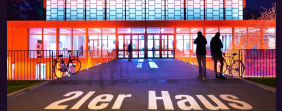
Das Video zeigt eine Auseinandersetzung mit dem Standortwechsel des Kulturzentrums bei den Minoriten in Graz.
Der Titel Standortwechsel ist hintergründiger als die reale Ergebnisbeschreibung einer ökonomischen Entscheidung, die einen ''Standortwechsel'' nach sich gezogen hat. Er hängt sich vielmehr an einer Ode an: ''Den Standort wechseln als Daseinsform.'' Der schlichte Satz stammt vom rumänischen Dichter Caius Dobrescu, einem der scharfsinnigsten Analytiker derzeitiger Gesellschaftsmaximen, veröffentlicht in seinem Lyrikband: ''Ode an die freie Unternehmung.''
Norbert Trummers Kunstprojekt ist somit nur scheinbar an einem konkreten Schauplatz und einer verlorenen Liebe zum Detail verortet. Es ist vielmehr ein Vollzug der Stellvertretung, der die Gesetze der Gegenwart, von denen wir glauben, dass sie gegeben oder gemacht, jedenfalls aber hinzunehmen sind, mit dem Charme der Zeit, einer anderen Art der Medialität und völlig anders gearteten Formen von Präsenz unterläuft.
(Johannes Rauchenberger, Quelle: http://alt.kultum.at/galerien/2011/Standortwechsel.htm)
-/-
The video shows a discussion about the relocation of Kulturzentrum bei den Minoriten in Graz.
The title "Relocation" is more profound than simply describing the outcome of an economic decision that resulted in a "change of location." Rather, it alludes to an ode: "Changing location as a form of existence." This simple sentence comes from the Romanian poet Caius Dobrescu, one of the most astute analysts of contemporary societal maxims, published in his poetry collection "Ode to the Free Enterprise."
Norbert Trummer's art project is thus only superficially situated in a concrete location and a lost love of detail. It is, in fact, an act of representation that subverts the laws of the present – laws we believe to be given or made, or at least to be accepted – with the charm of the times, a different kind of mediality and entirely different forms of presence.