
Kategorien
- Ausstellungsdoku
- Dokumentation Performance
- Film und Video
- Künstler*innengespräch
- Neues
- Programm
- Veranstaltungen

Blick-Wechsel
 /media/playercomm?action=mediaview&context=normal&id=65
326 views
0 favorites
 Schwentner, Michaela
Als Vitus Bering am 13. August 1728 den Nordosten Asiens umsegelte, um so zu beweisen, dass Asien und Amerika von einander separierte Kontinente sind, war die amerikanische Küste in Nebel gehüllt und blieb für den Entdecker weitgehend unsichtbar.
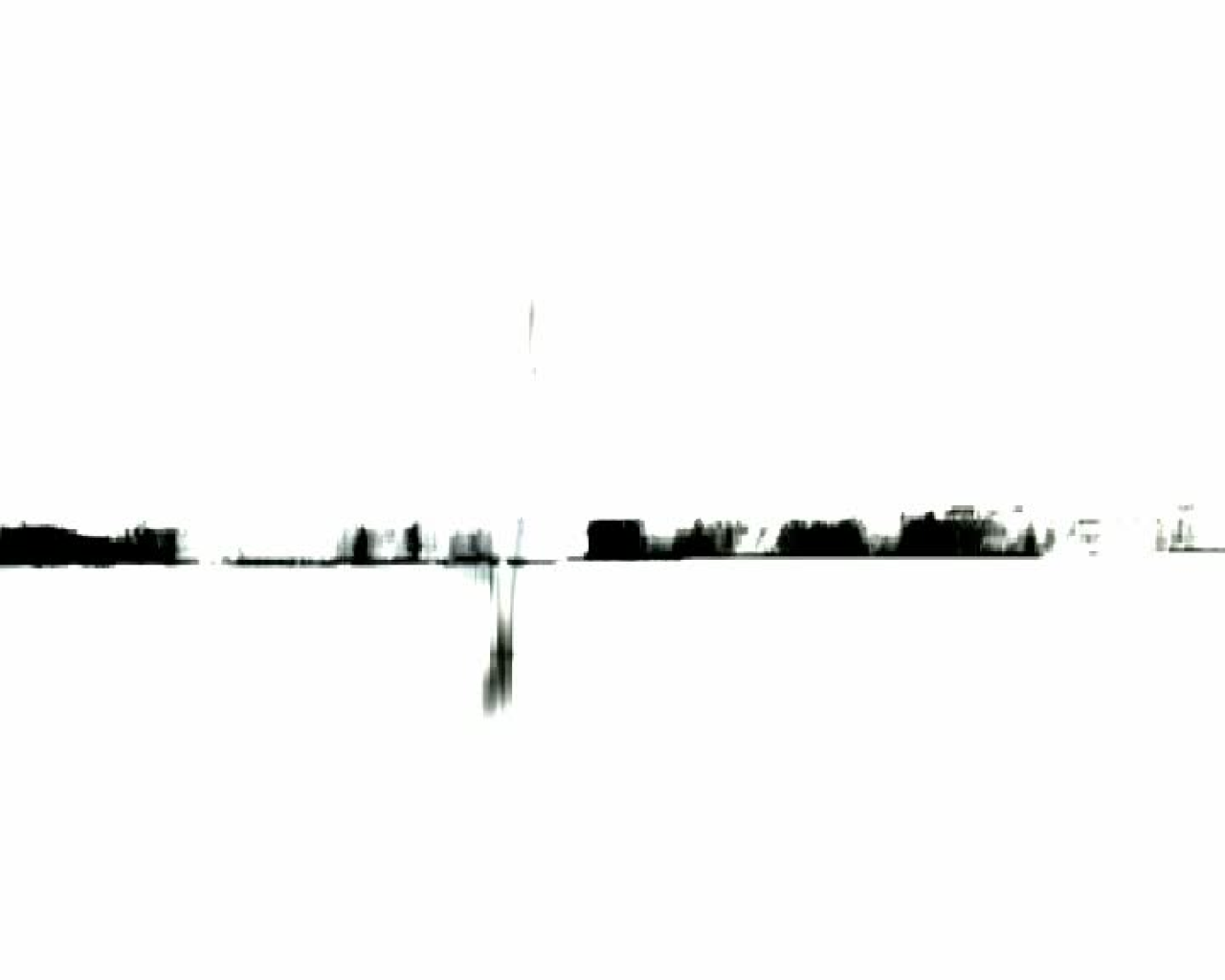
Der Erkenntnis auf der Spur – und zugleich doch im Dunkeln tappen: ein verwirrender Zustand, den Michaela Schwentners Video Der Kopf des Vitus Bering auf verschiedenen Ebenen spürbar macht. Das Bild zeigt aus blendendem Weiß auftauchend die schwarze Silhouette einer Landschaft, um eine horizontale – und ansatzweise auch vertikale – Achse gruppiert. Diese Landschaft verändert sich, oszilliert scheinbar zwischen verschiedenen Aggregatszuständen. Formen werden sichtbar oder unsichtbar; Farben fluktuieren zwischen Weiß-Grau-Schwarz. Eine Art Fata Morgana, in einer Wüste aus Eis. Auch der Sound und der Text referieren auf einen Zustand des Wahns – oder wenigstens erhöhter Sensibilität, die Bögen der Streicher sind gespannt, die Stimmen verwirren und verformen sich.
Konrad Bayers Text Der Kopf des Vitus Bering (1958 ff), aus dem alle Textzitate stammen, ist Schwentners unmittelbarer Bezugspunkt. Bayer interessierte sich für die Figur Bering als Standort, „von dem aus Beziehungen hergestellt werden“ und zitierte André Breton, dem zufolge die Wirklichkeit nicht die Summe der Fakten, sondern die Summe der Möglichkeiten sei. Bayers Text ist ein Mosaik aus Fakten, also Geschichte einerseits – und Gedanken, Spekulationen andererseits, montiert nach strengen Regeln. Er baut eine dichte Atmosphäre, deren Qualität in den Leerstellen liegt, die das Wissen um die Fülle, um die Wirklichkeit in sich bergen. Auch Schwentners Video atmet diese Intensität, Text, Sound und Bild verbinden sich zu mehr als nur der Summe des Gesehenen und Gehörten. Sie stellt die Fülle in ihrer Leere dar.
(Sylvia Szely, Quelle: www.filmvideo.at)
-/-
When Vitus Bering completed his circumnavigation of northeast Asia on August 13, 1728, to prove that Asia and America are two separate continents, the coast of America was covered in fog and remained largely invisible to the discoverer.
On the tracks of discovery and at the same time groping through the dark; a confusing state, the various levels of which are made evident in Michaela Schwentner's video the head of Vitus Bering. The picture shows the black silhouette of a landscape emerging from a brilliant white. The landscape is grouped on a horizontal and in some places also on a vertical axis. It changes and seems to oscillate between various aggregate states. Forms become visible or invisible; colors fluctuate between white-gray-black. A type of fata morgana in a desert of ice. Also, the sound and the text make reference to a state of madness - or at least heightened sensibility; the violin bows are tense; the voices entangle and distort.
Konrad Bayer's text Der Kopf des Vitus Bering (1958 ff.), which provides all the quotations, is Schwentner's immediate reference point. Bayer is interested in the figure of Bering as a location from which relations can be created and quotes André Breton, according to whom reality is not the sum of the facts, but rather, the sum of possibilities. Bayer's text is a mosaic of facts, thus on the one hand history – and on the other, thoughts and speculations, mounted according to strict rules. He creates a dense atmosphere whose quality lies in the gaps that hold the knowledge of wealth, of reality. Schwentner's video also breathes this intensity; text, sound, and image combine to something greater than the sum of what happens and what is heard. It presents the abundance in its emptiness. (Sylvia Szely, Translation: Lisa Rosenblatt)